




Tutankhamun's tomb was discovered by Howard Carter in 1922, providing important insights into Egypt's ancient history and cultural heritage. Several strange events during the discovery and in the years that followed led to the legend of the "Curse of Tutankhamun".
This mysterious story began in 1922 when British archaeologist Howard Carter and his team discovered the tomb of Tutankhamun, the young pharaoh of Ancient Egypt. Shortly after the opening of the tomb, excavation financier Lord Carnarvon died suddenly from high fever and blood poisoning. After Carnarvon's death, the message allegedly written on the door of the tomb, "Death will spread its wings to those who disturb the Pharaoh's peace", caused a media sensation. This, coupled with the similar deaths of others who entered the tomb, spread the legend of the curse rapidly.
Carter's close aide, Arthur Mace, fell ill after the discovery of the tomb and died within a few years. American railroad tycoon George Jay Gould, who visited the tomb, died of a fever soon after. Hugh Evelyn-White, one of the archaeologists working at the tomb, became depressed and committed suicide after it was opened.
Interestingly, strange illnesses and sudden deaths have been reported among the workers and archaeologists who worked on Tutankhamun's tomb. At least 11 members of Carter's team are known to have died of various causes within a decade of the opening of the tomb. The myth or reality debate has been going on for over 100 years.
Interestingly, the Egyptian curse also seems to affect Senator Bob Menendez. It has nothing to do with Tutankhamun, of course. But it has a lot to do with Egyptian gold bullion. Why? Let's start our journey through history, politics and geopolitics.
Bob Menendez, in full Robert Menendez, is a politician representing the state of New Jersey in the United States of America. He was born on January 1, 1954 and is a member of the Democratic Party. Early in his political career, he served in the New Jersey House of Representatives and the New Jersey Senate, and was mayor of Union City. Menendez's real rise in his political career began in 1992 when he was elected to the US House of Representatives. Since 2006, he has served in the US Senate. Previously, Bob Menendez was chairman of the Senate Foreign Relations Committee, but was forced to resign due to corruption and bribery allegations against him, but he refused to resign from the Senate and has repeatedly denied any wrongdoing or unethical behavior!!!
Menendez's career took off, especially in the early 1990s, and with it some controversy about his involvement in corruption. In 2015, in particular, he faced federal corruption charges, but in 2018 the case was curiously dragged out due to 'juror unanimity' and the charges against him were eventually dropped. The jurors struggled to reach a consensus on whether Menendez's actions amounted to bribery and corruption or friendly assistance. Please note, this is not an acquittal in the legal sense, it is a matter of interesting twists and turns during the trial and ultimately juror disagreements!!! During the trial, there were many fierce arguments and fights between prosecutors and lawyers. Perhaps most importantly, in April 2018, following the trial, the United States Senate Select Committee on Ethics "strongly admonished" Menendez for accepting gifts from donor Salomon Melgen without committee approval, failing to disclose certain gifts, and using his position as a senator to advance Melgen's interests. This warning is a final judgment of conscience that cannot be proven in court.
Bob Menendez is married to Nadine Arslanian. Nadine Arslanian is an American businesswoman of Armenian descent. She is known as an important supporter of Menendez in his political career.
The corruption allegations he has had to face for so long could seriously affect Menendez's political career and public image. In 2023, Bob Menendez and his wife Nadine Arslanian faced federal corruption charges. In September 2023, the couple was accused of taking bribes. They allegedly used their political influence to offer favors from some business people in exchange for gold, cash and luxury vehicles.
Federal prosecutors allege that the Menendez couple received bribes from
Wael Hana: Menendez allegedly bribed him to take diplomatic initiatives in favor of the Egyptian government.
Jose Uribe: Allegedly bribed Menendez in exchange for help on various issues.
Fred Daibes: Allegedly bribed Menendez to solve some of his judicial problems.
It is known that Menendez holds an influential position as the Chairman of the Senate Foreign Relations Committee and has been active on human rights, democratic reforms and international security issues throughout his career. However, it is also noted that Menendez has been associated with various controversies and rumors throughout his political career. These rumors include diplomatic overtures in favor of the Egyptian government, political donations and lobbying, illegal activities in the Dominican Republic, and allegations linked to Medicare fraud.
Bob Menendez's relationships with political donors and lobbyists have been criticized at various points in his political career. Menendez is thought to have used his influence to benefit these individuals.
Particularly noteworthy in the context of their relations with political donors and lobbyists are the following cases:
The Dr. Salomon Melgen Affair: Dr. Melgen is a longtime friend of Menendez and a major campaign donor. Charged with Medicare fraud, Melgen's lawsuits alleged that Menendez used his influence in the Senate on his behalf. Menendez argued that his actions were legal and intended to help his friend.
Dominican Republic Vacations: Menendez used Melgen's private plane and vacation home in the Dominican Republic and failed to report some travel expenses. This led to allegations that Menendez was protecting Melgen's interests. Menendez attempted to rectify the situation by reimbursing the travel expenses.
Port Miami Container Dredging Dispute: Menendez allegedly pressured the US government to protect Melgen's interests in a port security contract in the Dominican Republic. In Melgen's dispute with the Dominican government over container dredging work at Port Miami, Menendez allegedly exerted pressure.
Federal Corruption Case (2015): Menendez faced federal corruption charges in 2015. The allegations included that he used his political influence to help Melgen's personal and business affairs in exchange for gifts and campaign donations from Melgen. In a 2017 trial, the jury could not reach a verdict and the case was dismissed!!!
Menendez argued that his actions were within the law and aimed to help his friends. However, in the court of public opinion, these relationships and allegations have caused Menendez to question his ethical and legal boundaries.
Bob Menendez is a politician with a critical attitude in his relations with Turkey. In the current political process, this attitude has always been met with a question mark by Turkey, and it has not been understood how and why the problems in relations have evolved in such an adverse manner. Here are some of Menendez's attitudes and views on Turkey:
Recognition of the Armenian Genocide: Menendez has played an active role in the official recognition of the Armenian Genocide by the United States. In 2019, the US Senate passed a resolution officially recognizing this genocide. This resolution was harshly criticized by Turkey.
Eastern Mediterranean and the Cyprus Issue: Menendez has been critical of the energy resources in the Eastern Mediterranean and Turkey's Cyprus policies. He described Turkey's drilling activities off the coast of Cyprus as illegal and argued that these activities should be stopped. He also emphasized that the sovereign rights of the Republic of Cyprus should be protected.
Turkey's Domestic Politics and Human Rights: Menendez has also been critical of human rights violations and democratic backsliding in Turkey. In particular, he has criticized the crackdown on journalists, academics and dissidents. He has expressed concern about political imprisonment and freedom of the press in Turkey.
S-400 and F-35 Crisis: Menendez harshly criticized Turkey's purchase of the S-400 air defense system from Russia. He stated that this situation negatively affected the US participation in the F-35 fighter jet program. He supported the imposition of sanctions against Turkey.
Chairman of the Senate Foreign Relations Committee: Menendez is the chairman of the Senate Foreign Relations Committee. In this position, he has supported and led several bills and draft resolutions on Turkey.
Menendez's critical stance towards Turkey was received negatively by the Turkish government and contributed to diplomatic tensions between the two countries. However, although Menendez claims that his political positions are shaped in line with the principles of human rights, democratic values and international law, the aforementioned corruption, bribery, lobbying activities and, finally, the fact that his wife is of Armenian origin cause these positions to be seriously questioned.
Regarding Bob Menendez's harsh and critical positions on Turkey, it is generally believed that Menendez may have been influenced by certain lobbies and diaspora groups. Here are some of the rumors and allegations against him:
Relations with the Armenian Lobby: Menendez's efforts for the recognition of the Armenian Genocide and his criticisms against Turkey have led some circles to claim that he is under the influence of the Armenian lobby. It is argued that Menendez has strong ties with the Armenian diaspora and lobby and defends their interests. In particular, his active role in the recognition of the Armenian Genocide seems to support these allegations.
Greek and Cypriot Lobbies: Menendez's positions on the Eastern Mediterranean and Cyprus have led to allegations that he is supported and directed by the Greek and Cypriot lobbies. His opposition to Turkey's drilling activities off the coast of Cyprus and his defense of the sovereign rights of the Republic of Cyprus are considered as a policy in line with the interests of these lobbies.
Anti-Turkey Attitudes in US Domestic Politics: It is argued that Menendez's criticism of Turkey is part of a general anti-Turkey trend in US domestic politics. In particular, it is argued that due to some of Turkey's independent steps in foreign policy and its relations with Russia (e.g. the purchase of the S-400 defense system), some politicians in the US have adopted a harsher attitude towards Turkey.
Israel Lobby According to some allegations, Menendez's criticism of Turkey may be under the influence of the Israel lobby. The sometimes tense relations between Turkey and Israel and Menendez's support for pro-Israeli policies have led to such rumors.
Although the points I have tried to summarize so far are not based on conclusive evidence, they have been on our minds within the framework of the events that have taken place. For this reason, when I examine the issue in a little more detail, the picture that appears before me really raises our suspicions. In order to bring this issue to your attention, I find it appropriate to analyze Turkey-US relations.
Turkey-US relations have gone through many periods throughout history and have been shaped by various factors. The conclusion of the Second World War in favor of the US-led front and the development of two-front world politics on the US-USSR axis led to military polarization and brought about two main military pacts, NATO and the Warsaw Pact. Although Turkey remained neutral during the Second World War, it joined NATO after the war and became one of its first members. It is still the largest military power among NATO countries after the United States and the most strategic member of the alliance. In addition to being a NATO member, Turkey pursues a cosmopolitan foreign policy, maintains good relations with Russia and China, and takes serious steps towards independence by developing its own national solutions, especially in the military defense industry. This situation has been meticulously monitored by the United States, and when we take into account the situations in which the national interests of the two countries clash, we can see that politically, the relationship between the two countries has been on an up-and-down course since 1950. In the end, it should be recognized that there are very complex and complicated relations between the two countries.
If we turn the state of relations and fluctuations in diplomatic relations between Turkey and the US from 1950 to 2020 into a numerical graph for clarity, and if we assign a score between 1 and 100 on the Y axis (where 1 indicates the worst situation and 100 indicates the best situation), and if we place the years on the X axis, we see the following graph;
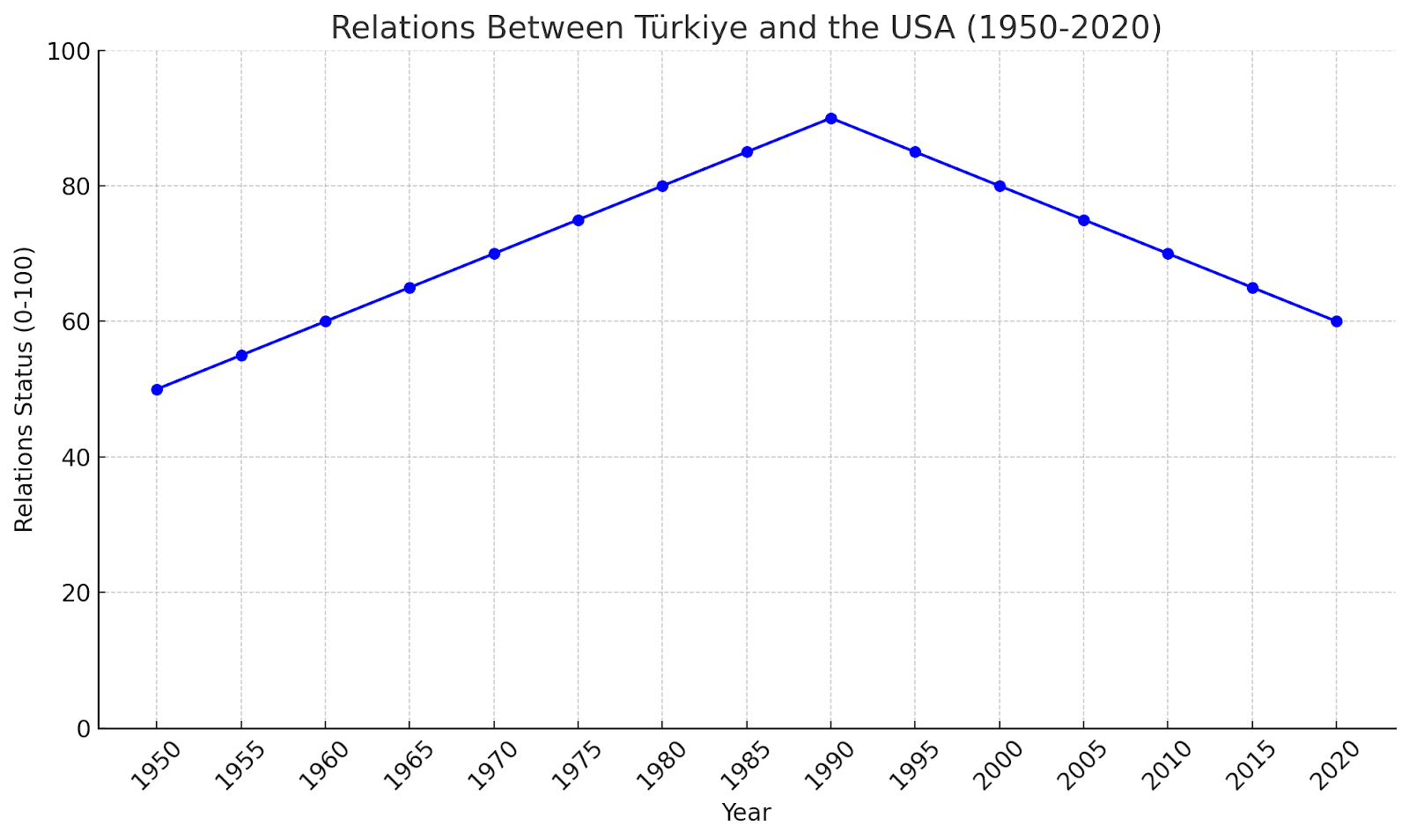
It should be kept in mind that this graph does not reflect all the relations between the two countries, but rather the general perspectives and the general trend. For example, the graph has been softened in order not to distort the general trend of the deteriorating relations between the two countries after the 6th Fleet soldiers visiting Turkey in 1969 were thrown into the sea and during the 1974 Cyprus Peace Operation.
As can be seen, relations, which had been on an upward trend until the 1990s, were severely affected after this date and started to decline. In the last 10-15 years, Turkey-US relations have deteriorated significantly due to various reasons. Some events and political developments during this period have increased tensions between the two countries. Here are the main reasons for the deterioration of these relations:
The Pastor Brunson Affair: Following the coup attempt in 2016, American pastor Andrew Brunson was arrested in Turkey and put on trial for espionage and alleged links to terrorist organizations. Brunson's arrest led to a deterioration in relations with the US. The US imposed economic sanctions on Turkey after Brunson was not released.
Allegations of Interference in Turkey's Internal Affairs: Turkey has accused the United States of interfering in its internal affairs. These allegations increased especially after the Gezi Park protests in 2013 and the attempted coup in 2016. The Turkish government has expressed its belief that the US had a hand in these events, which has negatively affected relations.
Relations between FETÖ and the US: Turkey blames the United States for the presence of Fetullah Gulen in the US. Blaming the Fetullah Terrorist Organization (FETO) for the July 15, 2016 coup attempt has led to mistrust and tension between the two countries.
PKK/PYD and the US Relationship: The US support for the YPG/PYD forces in Syria has been met with reaction by Turkey. Turkey argues that the YPG/PYD is an extension of the PKK and emphasizes that these groups should be considered as terrorist organizations.
Embargoes and Economic Sanctions: The US imposed economic sanctions on Turkey. These sanctions negatively affected economic relations between the two countries due to the non-release of Pastor Brunson, the purchase of the S-400 air defense system and Turkey's trade relations with Iran.
S-400 Crisis: Turkey's purchase of the S-400 air defense system from Russia has led to a serious crisis with the United States. The US stated that the S-400 system was incompatible with NATO systems and announced that Turkey would be excluded from the US F-35 program with this purchase.
These factors have led to erosion of trust and political tensions in Turkey-US relations. In particular, the recent Israeli massacres in Gaza and Palestine, and the unconditional support of the US, have led to a renewed strain in relations.12 These complex dynamics provide an important framework for the future cooperation between the two countries.
Let us now elaborate on some of the more complex of these reasons;
S-400 Crisis
Turkey has been facing the need for a modern air defense system for many years. However, negotiations with NATO allies failed to find a solution to meet this need. Regional developments and the outbreak of the Syrian civil war in 2011 led to an increased threat to Turkey.
Turkey decided to purchase an air defense system to counter the growing external threat. Naturally, it first communicated the situation to its main ally, the United States, and requested the Patriot System. However, this request was rejected by the US. This prompted Turkey to look for other countries to meet this need, and in 2017, Turkey began negotiations with Russia to purchase the S-400 air defense system. In December 2017, a $2.5 billion deal was signed and Turkey purchased the S-400 systems.
The United States argued that the S-400 systems were incompatible with NATO's F-35 fighter jets and removed Turkey from the F-35 program. However, similar Russian air defense systems were already in use in many NATO countries.
In December 2020, the US imposed sanctions against Turkey under CAATSA. However, Turkey argued that the S-400 systems were necessary for national security and stated that it would maintain its independent defense policies.
On the other hand, Turkey has turned to alternative collaborations in the defense industry and increased its efforts to develop indigenous defense systems. By 2024, Turkey's national and indigenous layered air defense system was fully commissioned, the first unmanned fighter jet, “the Red Apple”, entered mass production, and Turkey's 5th generation fighter jet Kaan started its maiden flights. This resulted in Turkey's rise to 3rd place in the world in modern warfare technologies after the US and China. The US sanctions and the decision to be excluded from the F-35 program accelerated Turkey's strategic changes in the defense industry and the movement towards full independence in defense systems.
The Case of the NATO Generals Inside Turkey
The "NATO generals" affair within Turkey has generated controversy about the relationship of some high-ranking officers in the Turkish Armed Forces (TAF) with NATO and how they serve Turkey's national interests. This issue has received more attention, especially after the July 15, 2016 coup attempt.
After becoming a member of NATO in 1952, Turkey took important steps to align its Turkish Armed Forces with NATO standards. This process required Turkish officers to serve in NATO missions and receive international military training.
As part of NATO membership, many Turkish officers received training in NATO countries and served in various NATO missions. This led to the formation of a segment within the Turkish Armed Forces that was seen as pro-NATO.
After the July 15, 2016 coup attempt, it was alleged that some high-ranking officers in the Turkish Armed Forces had close ties with NATO and that generals known to be pro-Western played a role in the coup attempt. As it will be recalled, over 250 civilian casualties occurred during this coup attempt.
Due to the fact that these officers had served in NATO and had close ties with the West, some people claimed that they had participated in the coup attempt. Following the coup attempt, there were large-scale purges in the Turkish Armed Forces. Thousands of officers and non-commissioned officers were dismissed or arrested, and many high-ranking officers suspected of having links to NATO were also dismissed.
The restructuring of the TAF led to fundamental changes in the command structure and the training system. These changes affected the TAF's future operational capacity and internal dynamics, but also had significant benefits in terms of full independence.
FETÖ and the US
FETÖ (Fetullahist Terrorist Organization) is an organization accused by Turkey of attempting to take over the country by operating covertly at various levels of the state, including the attempted coup d'état on July 15, 2016, and is considered to be affiliated with the United States, the CIA and Mossad. The leader of this organization, Fetullah Gülen, has been residing in Pennsylvania, USA since 1999.
Gülen traveled to the United States in 1999, citing health problems, and has lived in Pennsylvania ever since. He obtained a permanent residence permit (Green Card) in the U.S. and continued to live here. FETÖ has established an extensive educational and social network in the US. It has charter schools and foundations. It carries out lobbying activities in the US. The fact that FETÖ supporters currently enjoy special privileges in the U.S. and are under special protection by the U.S. government strengthens Turkey's claims. Turkey accuses the US of protecting and supporting FETÖ. Extradition requests and legal proceedings have led to strained relations.
It has been proven that officers directly directed by FETÖ were behind the coup attempt in Turkey. Thousands of people were arrested. Turkey demanded the extradition of Gülen from the US, but the US administration rejected the extradition request.
At this point, I present the following words of Henry Kissinger, which have gone down in history, for your information without comment; "America is strong for two reasons. It finds and kills traitors in its own country. It finds traitors in other countries and uses them."
PKK/PYD and the US
The PKK and PYD terrorist organizations have been a major source of tension in relations between Turkey and the United States. The PKK is globally recognized as a terrorist organization. The PYD and its armed wing, the YPG, are a renamed version of the PKK. Despite this, the PYD and the YPG have been allies of the US in the Syrian civil war. Meanwhile, what the US is doing in a civil war 10,000 kilometers away is another critical issue.
The PKK was founded in 1978 under the leadership of Abdullah Öcalan and has been waging an armed struggle against Turkey since 1984. The US has designated the PKK as a terrorist organization and has occasionally provided support to Turkey in its fight against the PKK. However, this support has been seriously contradicted by the US relationship with the PKK's Syrian branch, the PYD/YPG.
The PYD was founded in 2003 as the Syrian branch of the PKK. The YPG, the armed wing of the PYD, became more active with the outbreak of the Syrian civil war in 2011. The US chose the YPG as an ally in the fight against ISIS. Under the name Syrian Democratic Forces (SDF), the YPG received weapons, training and logistical support from the US.
Turkey considers the YPG as an extension of the PKK. It considers the YPG's presence in Syria and the support it receives from the US as a threat to its national security. Turkey has carried out many military operations against the PKK/PYD/YPG/SDF in Syria within the framework of reciprocity engagement in many attacks on its territory within Syria. In the meantime, Turkey knows and says that these different designations consisting of these 3 letters were invented by Brett McGurk, one of the names shaping the US Middle East policy, in order to confuse, whereas they are all PKK.
The Impact of the Events in Gaza on Turkey-US Relations in the Israeli-Palestinian Axis
The Israeli-Palestinian conflict, especially the events in the Gaza Strip, has occasionally caused tensions in relations between Turkey and the United States. Turkey has historically supported the Palestinian cause and defended the rights of the Palestinian people. In particular, the government led by Recep Tayyip Erdoğan has taken a clear stand against the Palestinian struggle for independence and against Israel's policies. Turkey has provided massive aid in response to the humanitarian crisis in Gaza and has carried out various projects to support Palestinians in the region. However, Israel's military operations against Gaza and the Mavi Marmara incident negatively affected Turkey-Israel relations and led to a crisis that also affected Turkey-US relations. The US, as one of Israel's strongest allies, has provided extensive support for Israel's security. This increased Turkey's criticism of the US and led to diplomatic clashes. Bilateral relations have at times been cold and tense. These events have been an important factor that negatively affected Turkey-US relations. Regional policies also affected these relations and led to a crisis of confidence between the two countries. The events in the Israeli-Palestinian axis have negatively affected the relations between Turkey and the US.
US Need to Improve Relations with Turkey
The tensions in world politics in recent years, especially the growing influence of Russia and China, have made it necessary for the US to reconsider and improve its recently deteriorating relations with its NATO ally Turkey. So, why does the US need Turkey's support and what steps can US take to improve these relations?
First of all, I would like to point out that according to a study conducted by the US-based Global Firepower, Turkey is the 8th most powerful army in the world and the 3rd most powerful army in NATO. In terms of experience, the Turkish Land Forces are at the top of the world. In recent years, the Turkish Defense Industry has also made great strides in new military technologies. In terms of military power, Turkey is an indispensable ally for the United States.
In recent years, Russia and China have made great progress in both military and economic fields and have started to play a more prominent role in global politics. Russia has posed a major threat to NATO, especially with its military intervention in Ukraine and its influence in Eastern Europe. China, on the other hand, has increased its global influence with its military presence in the South China Sea and projects such as the Belt and Road Initiative.
These developments have led the US to rely more heavily on its NATO allies, especially strategically located countries like Turkey, to protect its global strategic interests. Turkey has a critical importance for regional security and stability due to its geographical location and military capacity. Turkey's NATO membership and cooperation with the US is seen as a counterweight to the growing influence of countries such as Russia and Iran in the region. It should also be noted that Turkey is an important partner for Europe and the United States in the migrant crises and the fight against terrorism.
Recent tensions in world politics have required the United States to reassess its relations with its NATO ally Turkey. Turkey's strategic importance and military capacity are critical to US regional and global objectives. To improve relations with Turkey, the United States must take steps in the diplomatic, economic and defense spheres and rebuild trust between the two countries.
Having made these assessments and analyses, I would like to draw a connection between the historical course of Turkey-US relations and Bob Menendez's progress on the political scene. In fact, although this may seem like a conspiracy theory, my belief in this matter is clearly established.
In order to make it easier to understand the issue, I have tried to summarize Bob Menendez's political talking points in a table below.
When we evaluate this table together with the previous table on Turkey-US relations, it seems like an interesting coincidence that the negative developments in the relations between the two countries coincide with the years when Bob Menendez started to be influential in the US in his political career. However, due to Menendez's close ties with corruption, bribery and lobbies, this coincidence seems more like a purposeful move. The possibility that Menendez may have been protected, especially with the interesting developments in the judicial process, makes it more likely that he was an organizer than an actor. Or at least a politician who pursued his own personal interests under the influence of political corruption and pursued policies favorable to the powerful Armenian, Greek and Israeli lobbies in the US. Unfortunately, I do not have the opportunity to prove these allegations here, which have not been proven even within the US judicial system. But in my opinion, Menendez and his wife seem to have less chance of escaping the curse of the Egyptian gold.